Wednesday, June 2, 2021

Family Lawyers Mackay Specialise In The Resolution Of Complex Family Law Matters.


Family Lawyers Mackay is a family law firm specializing in all family law financial matters dealing with marriage or other relationship breakdowns including de facto and same-sex relationships, and issues relating to children. We also advise on and prepare prenuptial and financial agreements.

Our lawyers will use their vast experience, commitment, understanding, and communication skills to help you achieve your objectives.

We are based in Mackay, Queensland but have assisted clients whose relationships and financial affairs transcend national boundaries, many with complex financial affairs.

Complex Family Law Matters.

One of our Directors is an Accredited Specialist Family Lawyer. Ian Field has now represented a vast range of clients both in Australia and Overseas. Our international connections allow us to assist you no matter if you are local or living away from the area.

Our primary aim is to help you resolve issues resulting from a broken relationship quickly, and cost-effectively. We work with you to reach your objectives and resolve the matter in a way that makes the best of a tough situation.

Family Lawyers Mackay With An Edge.

Family Lawyers Mackay is fast becoming recognized as a First Tier family law firm in Regional QLD and Australia. We have 6 lawyers accredited by the Law Society of Queensland at our firm. Their expertise enables us to focus on what we do best: resolve complex family law matters. We are big enough to make a difference and small enough to care!

We have expertise at every level of experience and our primary emphasis is on treating all of our clients as people first, not numbers.

At the commencement of the collaborative process all parties and their lawyers will enter into a Participation Agreement. Pursuant to the terms of the Participation Agreement the parties agree that they will not litigate their matter in the Family Court. This means that if either you or your partner decides to commence proceedings in Court and continue with such proceedings during the collaborative process, your collaborative lawyer will not be able to represent you in the collaborative process they will only be able to refer you to another trusted practitioner to handle your Court case.

How does it all work?

Collaborative practice is different from going to Court. You will be in a room with your lawyer as well as your partner and their lawyer. Both lawyers will be properly trained in the collaborative approach. We all work together towards the common goal of resolving the dispute between you and your partner, with emphasis on retaining your dignity and best interests.

You will have your collaborative lawyer advising and assisting you throughout the negotiations. The playing field will be more even between you and your partner, because you and your partner will have your respective lawyers to support you, as well as other

The integrated approach of Collaborative practice

Collaborative lawyers often work with other professionals, such as accountants, financial planners, valuers, counsellors and mental health professionals, who are trained in the collaborative approach. These people will work together with your collaborative lawyers with your consent with a focus on developing an overall dispute resolution package that will provide both you and your partner with security and direction.

Note: In Collaborative practice, your lawyer and your partner’s lawyer will draft your agreement in legal terms.

Article Source: Family Lawyers Mackay Specialise In The Resolution Of Complex Family Law Matters.

Tuesday, June 1, 2021

Top 10 Family Law Questions in Mackay


We deliver to you the Top 10 Family Law Questions asked to us by our clients in Mackay.

1. What is a Legal Separation and Divorce?

A Legal Separation or Divorce is a legal recognition for the conclusion of your marriage.

You gain a Divorce if your marriage has broken down irretrievably and you’ve been officially separated for a minimum of 12 months.

Importantly, you don’t have to prove who was “at fault” and you don’t have to wait for the full 12 months after separation to conclude a property settlement.

2. What is the definition of a de facto relationship?

Contrary to public belief, there is no single “legal definition” of a de facto relationship because there are different requirements for various legal purposes.

Generally-speaking though, a de facto relationship exists between 2 persons (who aren’t legally married) of the same or opposite sex (who aren’t related by family) and, to all intents and purposes of the partnership, have a relationship the same as that of an officially married couple living together on a genuine domestic basis.

3. What is child support or child maintenance?

As soon as you are separated, you can lodge an Application with the Department of Human Services (Child Support) to have child maintenance or child support assessed for your child in the event you are unable to come to an agreement with the child’s other parent.

4. What is a Parenting Order and is it important?

A Parenting Order made by the Court will often deal with the following issues:

  • Determination of parental responsibility (i.e. who will carry the duties, powers, and authority, which by law parents have) regarding the children (whether solely or jointly cared for);
  • Who the children are to reside with; and further
  • How the children are to spend time with each parent;
  • All other aspects of the care, welfare, and development of the children, as well as any other aspect of parental care for the children.

When a Parenting Order is made by a Judge, it is a legal requirement that all parties follow the Order specifications.

If a parent refuses to follow a Parenting Order (and is unable to show a reasonable excuse), it is called “contravening a Parenting Order”.

There are serious ramifications which flow from a contravention of a Parenting Order such that it is possible for the Court to order parents to attend programs, facilitate “makeup” time, enter a bond, pay a fine or even 12 months imprisonment.

It is therefore important that you read and understand the terms of a Parenting Order made by a Court.

5. How does a Court determine who the child will live with and spend time with?

Contrary to popular perception, there is no “fixed rule” about whom a child shall stay with (previously referred to as “child custody”) and whom a child shall spend time with (previously referred to as “child access”).

The Court’s top priority in determining which parent the child shall live with and how much time the child will spend with the other parent is what is in the “best interests of the child.”

The Family Law Act 1975 sets out the main factors that are to be taken into account in determining the best interests of the child or children.

6. How does a Judge determine a property settlement amount?

Contrary to belief, the process that the QLD Courts use to calculate a family law property settlement, is not a “mathematical” one.

Unlike in other countries and regions, there is no “starting rebuttable presumption” that the parties’ net property pool is equally divided “50/50.”

Each relationship is considered unique and is determined based on a number of discretionary factors.

The Court has a wide scope to consider in making the property settlement orders and as a result, the outcome can vary significantly.

For example, you could potentially get 10 unique outcomes before 10 unique Judges on any given day at Trial and each outcome would be legal and acceptable, as long as it falls within a range of plausible outcomes.

In general practice, the Judge generally adheres to a well-established process that involves a number of steps to determine the entitlement of each party in the relationship.

These steps are as follows:

  • The Court must decide if it would be just and equitable to adjust or change the parties’ current legal ownership of assets.
  • To list all of the current assets, liabilities, and superannuation of each of the parties and arriving at a net figure, or what becomes known as the “total net property pool”.
  • To ascertain the contributions of each of the parties throughout the relationship, to the net property pool and to the welfare of the family. Contributions can be direct (eg. made by one of the parties’ to the relationship) or indirect (eg. one of the parties’ family members contributions), financial (eg. earning money) or non-financial (eg. improvements to a property performed by one party) or made as a homemaker or stay at home parent. Each of these contributions is determined as a single percentage or a range of percentages.
  • To assess the current and future circumstances of each of the parties and make adjustments to the percentage arrived at in step 3 above. The list of factors can be found in Section 75(2) of the Family Law Act 1975 including:
    • The age and state of health of both of the parties;
    • The income-earning capacity or a financial discrepancy between both of the parties;
    • The total length of the relationship and its overall effect on both of the parties earning capacities; and
    • Who has primary care of the children into the future
  • For the Court to “step back” and assess whether the percentage or division achieved by the application of the above 4 steps is suitable or “just and equitable” in the overall sense.

7. What is a spousal maintenance payment?

Spousal maintenance is sums of money paid from one spouse (i.e. the paying party) to the other (i.e. the receiving party) in situations where the receiving spouse is unable to support themselves “appropriately”, after separation.

When determining if spousal maintenance is suitable, the Judge will consider:

  • Whether a “threshold” is met (i.e. if there is a “requirement” for one of the parties to be financially supported by the other);
  • The capacity of the paying party to support the receiving party for a period of time; and
  • The outline covered in Section 75(2) of the Family Law Act 1975; and
  • The overall extent of financial support needed (i.e. what is ‘suitable’ under the circumstances) and the amount of time support is needed to be paid for.

Most importantly the Court is not required to ensure that either party has the “same standard of living” that they had during the relationship.

8. Must I formalise my property settlement in Court?

After separation, it is critical to formally resolve the issue of a property settlement and have any agreement formally recorded in “Consent Orders” (which is lodged at and approved by a Judge at the Family Law Courts) or enter into a Binding Financial Agreement as per the Family Law Act 1975 (known as a “BFA”).

Unless a property settlement is ruled on by a Court Order or is properly recorded in a Consent Order or BFA, the issue of property settlement is always potentially “alive” (albeit subject to time constraints) and either one of the parties can commence proceedings in the future to make a claim against the other party.

Costs savings and tax advantages in transferring property and signing documents pursuant to a Consent Order or a BFA may also be possible. This will include implications such as capital gains tax and stamp duty exemptions.

9. Are there any relevant time limits to be aware of in Family Law property settlements?

Be aware that parties must resolve or commence proceedings for a property settlement and/or spousal maintenance within 12 months after you have obtained your Divorce officially.

Alternatively, you must seek leave of the Court to do so (which is generally only allowed under exceptional circumstances). This is normally a difficult, costly and lengthy process.

Note that a financial claim at the end of a de facto relationship must be filed within 2 years after the date that the de facto relationship ended.

Parties can (and should) commence negotiations or file an Initiating Application for property settlement and/or spousal maintenance immediately upon formally separating from their spouse based on the irretrievable and permanent breakdown of the relationship.

10. Do I need to update my Will, Superannuation, and Powers of Attorney or Enduring Powers of Attorney upon separation?

After formal separation, it is critical to examine the terms of your Will (if you have one) or create a new Will to properly reflect the change in your circumstances.

It is also very important to consider who is named as a beneficiary in your Superannuation policy and if you wish to change the beneficiary (as in most cases, this will be your spouse).

Also, examine any Powers of Attorney and/or Enduring Powers of Attorney you put in place during your relationship. In most situations, it may be advisable to revoke those Powers of Attorney as soon as possible after formal separation.

If you have a different question regarding Family Law, we’d love to hear from you.

Saturday, May 22, 2021

Do I Have To Move Out To File for Divorce?


This is a very common question and a natural thought to have if you are thinking about, or planning to get divorced from your spouse. In some circumstances, where the situation might be particularly volatile, both partners are keen to escape each other anyway, so one moving out isn’t even really an issue as they want time apart as soon as possible.

However, separation is not always that easy or “instant”. The house you both live in might be owned by the pair of you. If there are children involved, neither parent is going to be keen to hurry up and move out and be away from their children and the familiarity of it all.

Ultimately, if you are getting divorced you will eventually be going your separate ways, but in order to file for a divorce in the first place, do you have to be separated literally?

The law states that for a couple to seek a divorce, they must first be separated for a period of 12 months and that the relationship has gone beyond the point of being salvageable.

Although the Family Law Act 1975 makes this statement, that doesn’t mean you and your partner have to physically be separated and living at different addresses for a year before getting divorced.

Living separately under one roof is extremely common these days and this is officially recognized. It’s also very understandable as both parties are going through the processes of breaking up, talking to the children, making arrangements for after the divorce, and so on. It’s also not always financially viable to physically separate immediately.

If you are thinking divorce is imminent, or you and your spouse have discussed that divorce is the best course of action to take, then make an appointment with a family law expert to discuss your rights and your options. It’ll put your mind at rest.

Article Source: Do I Have To Move Out To File for Divorce?

Thursday, May 20, 2021

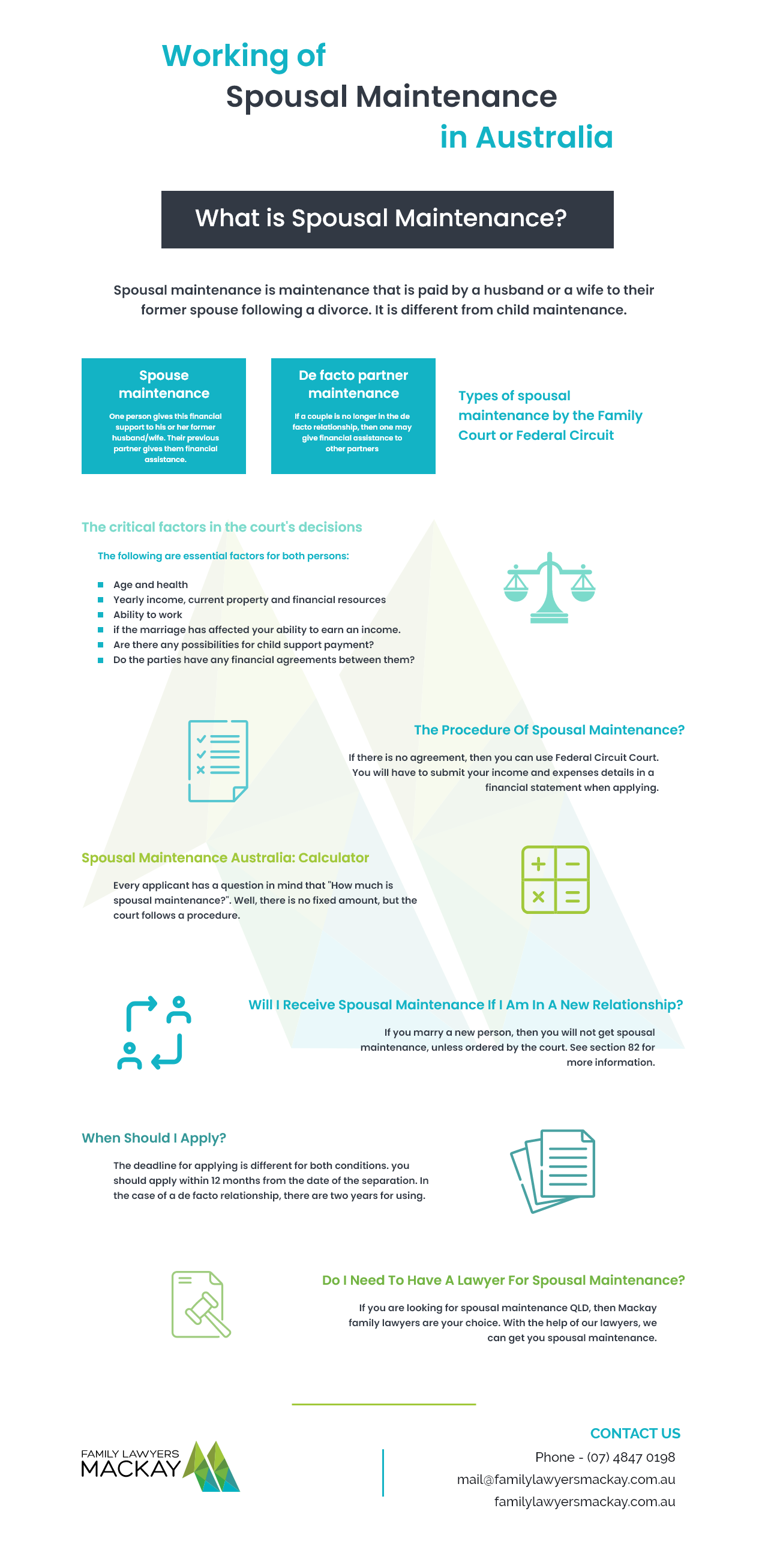
Working of spousal maintenance in Australia


People might ask “what is spousal maintenance?”, the answer is quite simple: it is financial assistance given by one ex-partner to the other if they are financially unstable. Spousal maintenance in Australia can also be paid by lump sum in lieu of spousal assets to be shared, such as boats or cars.

There are two types of spousal maintenance, the Family court or the Federal court deals with them. 

  1. Spouse maintenance: One person gives this financial support to his or her former husband/wife. Their previous partner gives them financial assistance. 
  2. De facto partner maintenance: If a couple is no longer in the de facto relationship, then one may give financial assistance to other partners. 

The family law Act 1975 states that a person is responsible for assisting the former de facto 

What are the critical factors in the court’s decisions:


Before making a decision, the court checks the applicant’s needs and the financial stability of the respondent. The following are essential factors for both persons:

  • Age and health
  • Yearly income, current property and financial resources
  • Can the applicant work?
  • Standard of living
  • Has the marriage affected financial status?
  • Are they supporting any other person? 
  • Do any of the parties have social security benefits?
  • How much one has contributed to the financial state of the other.
  • How much has the relationship affected the earning of the applicant?
  • Are there any possibilities for child support payment?
  • Do the parties have any financial agreements between them?

You can see section 75(2) (married) and for de facto check 90SF (de facto) to know more.

Can I have spouse maintenance if I was in a de facto relationship?

If you were in a de facto relationship, and now you want to apply for spouse maintenance then give a read to De facto property regime page it is on the Attorney-General’s website. You will know whether you are eligible for spousal support or not.

The law is different for people living in Western Australia. You should visit the website of the Family court of Western Australia. 


What is the procedure of spousal maintenance?

It is good to have an agreement with your spouse before applying for spousal maintenance. If there is no agreement, then you can use the Federal Circuit Court. You will have to submit your income and expenses details in a financial statement when applying. The spouse will follow the procedure. 

If there is an urgent need for financial assistance, then the court may order immediate payment. 

Spousal Maintenance In Australia

Spousal maintenance Australia: calculator

Every applicant has a question in mind that “How much is spousal maintenance?”. Well, there is no fixed amount, but the court follows a procedure. We have tried to explain it below. 

The court will check the financial condition of the applicant and the capacity of the spousal, after that the court will make a judgement about the payable amount. There is no formula for calculating spousal maintenance.


The court assumes the day-to-day expenses of the applicant and the respondent, and then it will be decided whether to pay the spousal support or not if it is payable then how much. 

If the applicant is responsible for taking care of the child or children below the school-age, then the court will not ask you to work as the children will need full attention. But, once the children reach the school-age, you will need to work unless you do not have some other responsibilities. 

Will I receive spousal maintenance if I am in a new relationship?

If you marry a new person, then you will not get spousal maintenance, unless ordered by the 

If you are in a new de facto relationship, then the court will consider your financial status and of your new partner and will make an original decision according to that. 

When should I apply?

The deadline for applying is different for both conditions. Suppose you were married and had a divorce. Then you should apply within 12 months from the date of the separation. In the case of a de facto relationship, there are two years for use. 

If you are unable to apply within time, you can have special permission from the court for use even after the time. But, you will not get this chance if you don’t have a valid reason for the late submission of the application.

Do I need to have a lawyer for spousal maintenance?

You should contact experienced family lawyers when applying for spousal maintenance. 

There are many essential factors in a spousal order. Every case is different, and the conditions vary from person to person. The payable amount changes from case to case. It would help if you considered experienced family lawyers to understand your situation. 

If you are looking for spousal maintenance QLD, then Mackay family lawyers are your choice.

Source: Working of spousal maintenance in Australia


Tuesday, May 18, 2021

When is Child Support Applicable and What Does It Cover?


The financial wellbeing of the children is always of the highest consideration when couples separate or divorce. If one parent has custody of the children, for the most part, that doesn’t mean the other parent is no longer obligated to offer financial assistance for the expenses of the children.

So what things does child support typically cover?

The general and rather a broad list includes:

  • Schooling
  • Medical costs
  • Food
  • Housing
  • Clothing
  • Extracurricular activities

Generally, child support is paid by the partner with more income, but less time with the children. The amount is typically negotiated depending on the state of the relationship after the breakdown of the marriage or de facto partnership.

To have an idea of how many children support you might likely be required to pay, you can visit the Child Support Agency (CSA) website and make use of their child support calculator, which takes into account the income and circumstances of both parents, as well as how many children under the age of 18 are involved. This is an estimation tool only.

It’s always the best course of action to be able to work out financial care for the children outside of a courtroom. While it’s not always possible, it is the most amicable.

Some parents may insist on child support amounts that are unfair or too high, desiring to use the money to pay for health insurance and private schooling. While health and schooling come under the broad categories of child support mentioned above, private school fees and premium health insurance policies are up for negotiation between both parents.

To effectively mediate the child support agency process so it’s fair for everybody, it’s best to collaborate with your legal representatives. You need to team up with a law firm that has experience and expertise in collaborative law and family law.

That team in Brisbane is Aylward Game Solicitors. With specialist training in this field and many years of practical experience, we are the law firm you can count on for an expedient and fair resolution to your child support requirements.

Article Source: When is Child Support Applicable and What Does It Cover

Tuesday, May 11, 2021

What Are The Effects Of Changing The Nature Of Parental Responsibility On The Life Of A Child?


By law, there are some defined duties, powers, authority and responsibilities of parents for their children. These are known as parental responsibility. The responsibilities include child’s growth, education and religion. Give them a proper environment and teach them discipline. You will have to take legal proceedings on your child’s behalf. The key responses in regards to the changing nature of parental responsibility initiated by the legal system are the Family Law (Shared Parental Responsibility) Act 2006 (Cth)

You will find different duties of parents in various statutes. For instance, according to 285, 286 Criminal Code Act 1899, the parents must provide the child all the necessities including medical treatment, lodging, clothing, food and care. Also, it is stated in 176 Education General Provisions Act 2006 QLD, that it is the duty of parents to enrol the child in a school and ensure attendance. The concept of the changing nature of parental responsibility has seen immense change in responding to recognizing the responsibilities parents possess in regard to aligning decisions with the child’s best interest, as particularly stated in Article 3 of Croc.

Who has parental responsibility?

According to the parental responsibility family law act, original parents or artificial surrogacy parents are authorized for parental responsibility. They do not need a court order for that. The grandparents or the step-parents can get involved in the care of the child. They have the authority to make decisions for the child.

It continues till the child is 18 or the marriage ends. The court wants the parents to share their responsibilities even after divorce. So, the child can have love from both parents. Parental responsibility applies whether the parents were married, or they were in a relationship.

Equal shared parental responsibility:

If the child is under 18 and the parents are no longer together, then they can share the responsibilities of the child. It is called equal shared responsibility. None of them can decide the long term issues of the child. For instance, a child’s school, medical treatments and religion.

It is applicable until the court gives an order in the best interest of the child. It can remove parental responsibility from one or both parents. 

When parents are not together:

When the parents are no longer together, there is a need to make arrangements for the care of the children. The adults and parents can make their own decision. This decision is acceptable until it is in the favour of the safety of the child, else get help from the court.

If the parents are unable to communicate effectively they can request the court to give a parenting order.

The court will decide that:

  • With whom the child will live.
  • How much time can the child spend with each person?
  • Responsibility of each parent.

If a child under age 18  leaves home, the parents or the state can force him to come back. In the case of a child with an age of more than 18, you cannot force them.

Rights of parents:

The parents also have rights. Parents can raise their children according to their wish. They can transfer their beliefs and religion to their children. They can also make decisions for their education and medical treatment. You have all those rights unless the child’s life is at risk.

The working parents have the rights to access the information of child-care services on payments.

The rights of parents do not include the custody of the child. For instance, after separation, the court makes a decision in the favor of the child’s best interest.


Changing the nature of parental responsibility in Australia:

The time is not always the same. A happy marriage can turn into separation and then may lead to divorce. So, in this case, parental responsibility can change. It is good if both parents share the responsibilities even after this situation. But, if the parents are unable to make a decision they will need help from the court. The court tries to make a decision to give the child a good life. In this scenario, the court can take or give more rights and responsibilities to each parent. If a parent is earning more he or she will have to donate more in the life of the child. 

But the parents should remember that their decision must not affect the life of the child. They have to try and give equal love to their children. This love will not just make them happy but also they’ll have confidence in them. So, don’t fight in front of your children.

Frequently asked questions:

Let’s discuss some of the most commonly asked questions about parental responsibility.

What is the sole parental responsibility in Australia?

Insole parental responsibility only one parent has complete rights for making major decisions for the child. It is just the opposite of parental responsibility, where both parents have equal rights in making crucial decisions.

How to get sole custody of a child in Australia?

If you want sole custody then you will have to apply to court. Also, you will have to provide a full report which explains all the matters against the other parent. If you can prove to the court that the other parent is not eligible for parenting responsibility then you will get sole custody.

When can a child make decisions?

By law, a child cannot make a decision until he or she turns 18 years.

When a parent is unfit in the eyes of the child?

There are certain conditions when a parent is unfit in the eyes of the court. For instance, abusing, failing to provide the child with necessities. In these situations, the court can reconsider its order.

Is it legal for my husband to take my child away from me?

Sometimes it is illegal to take the child away from the parent. But if you are married and you don’t have a court order then it is legal for the other parent to take the child away. Also, if your partner has sole custody it is legal for him or her to take the child.

Article Source: What Are The Effects Of Changing The Nature Of Parental Responsibility On The Life Of A Child?

Sunday, May 9, 2021

What are Family Law Contraventions and Breach of Orders


There is little that is more frustrating than receiving Final Court Orders about child support or parenting arrangements, only to have the other parent contravene or disobey the final Orders, causing a breach of orders. There was the case, a father was jailed for six months for contravening family court orders to return a boy from the Middle East to his mother in Australia. In that case, the penalty was employed as a coercive measure designed to compel the father to cause the return of the child, rather than a punitive one.

Our solicitors are often asked by our clients in this situation: “What can I do about my ex’s breach of Court Orders?”

Put simply, the answer is yes.

Complying with Parenting Orders

When the Court Orders are made, both parties are required by law to follow them. This means the parties must take all reasonable steps to ensure that the Order is adhered to and put into effect. Children must also comply with the Orders.

If a party does not comply with the Court Orders, they are then deemed to have contravened the Orders, and harsh penalties may be applicable.

Sometimes, a form of contravention can be unintentional and occur because one party doesn’t fully understand what the Orders mean. It is therefore critical that all parties to Court Orders fully read and comprehend the contents and meaning of the Orders.

In certain situations, there may be other valid reasons as to why a parent contravenes an Order. For example, if a parent was unable to transport a child to the changeover location because of floodwaters or other mitigating circumstances outside of their control.

Having said this, if a party lacks a reasonable excuse, and the breach is willful, persistent or serious, the other party can then make an application to the Court.

Serious penalties for Contravening Family Court Orders

In the event that your application to the Court is successful and the Judge makes a finding that the other party has contravened the Parenting Orders without a valid and reasonable excuse, then there are a number of ways the Court can proceed.

Depending on the situation and the type and seriousness of the contravention, a Judge may make orders to –

  • The original Order is changed.
  • One or both parents attend a parenting program after separation.
  • Compensation is allowed for time lost with a child, for example by ordering that a party has “makeup time” with the child.
  • The contravening parent enters into a bond.
  • The contravening parent pays some or all of the legal costs.
  • The contravening parent pays an amount for the reasonable expenses lost as a result of their contravention.
  • The contravening parent participates in community service work.
  • The contravening parent pays a fine, or
  • The contravening parent serves a jail sentence.

Seek Help from an Experienced Family Lawyer

We will help you. If you are on the receiving end of this type of breach and thinking about applying to the Court to assist with the other party not following Orders, we recommend you speak to an experienced family lawyer first. It’s also important to decide early on what you wish to achieve. For example, if you would like to have the existing Orders amended, then a contravention application is not your only option. In fact, depending on what you want to have changed, this may not be the best course of action to take.

You may first be required to attempt to resolve the situation by alternative dispute resolution (known as ADR). To check, read section 60I here or visit the Government family court website.

In the event you simply want the other party to “adhere to the Orders”, you are well-advised to speak with an experienced family lawyer. They can explain your particular options and even help you to choose the best course of action. They can also represent you at Court if needed.

If the other parent has already made an Application for Contravention of Orders and you have been named as the Respondent, then it is critical to obtain advice from an experienced family lawyer immediately to discuss the best strategy.

Article Source: What are Family Law Contraventions and Breach of Orders